01
Generate
Large candidate pools explore circuit topology, delays, thresholds, weights, and population structure.
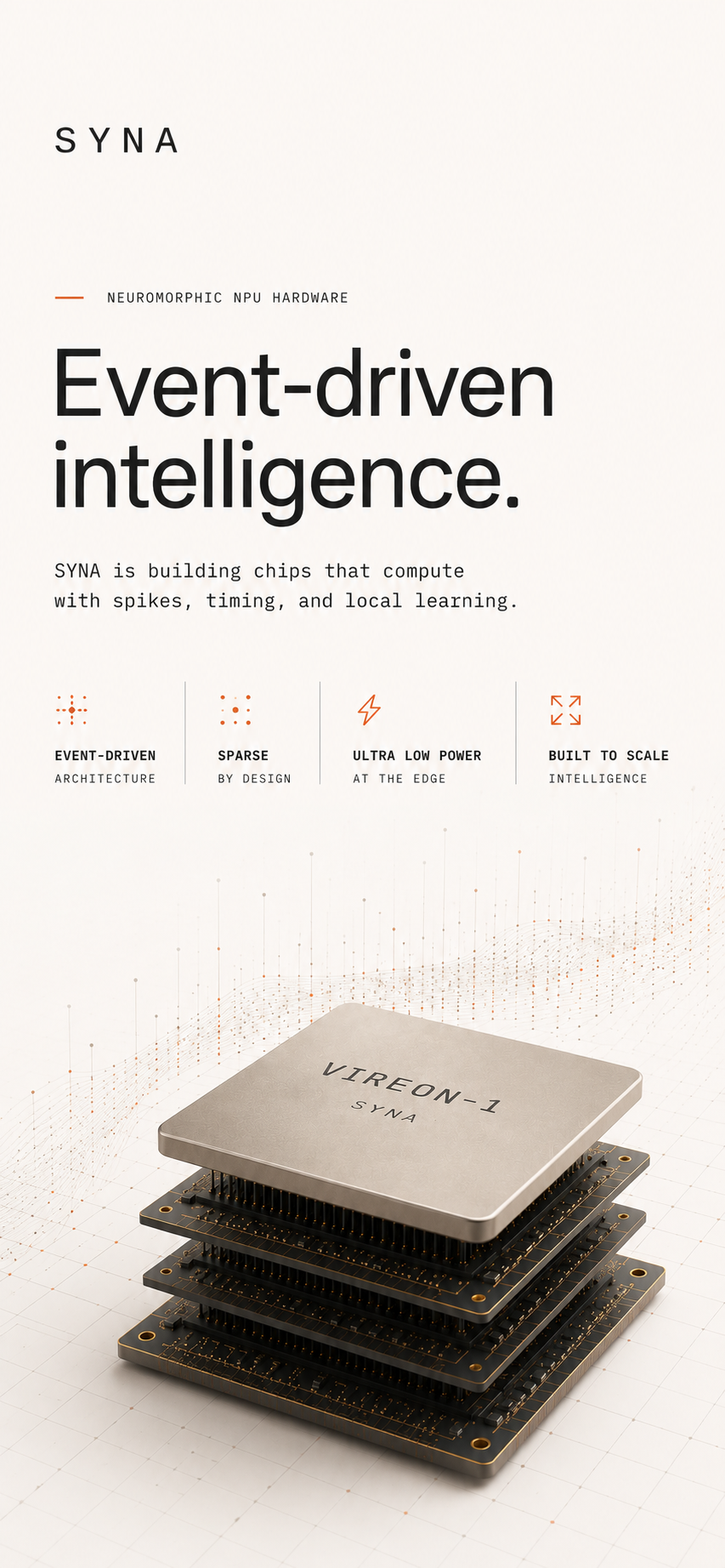
SYNA is building chips that compute with spikes, timing, and local learning.
GPUs move tensors.
SYNA moves events.
SYNA does not start with a fixed hand-designed circuit. Candidate programs are generated, simulated, attacked, and selected. Surviving patterns become hardware primitives for Vireon-1.
Large candidate pools explore circuit topology, delays, thresholds, weights, and population structure.
Every candidate is tested against timing, energy, logic, noise, and hardware failure modes.
The survivors become the source material for the next generation and the hardware primitive library.
Validated profiles map into the Vireon-1 stack: Spike Core, Plasticity Engine, and Reason Core.
Layer 1 detects events. Layer 2 adapts weights. Layer 3 wakes only when slower reasoning is needed.
Always-on event computation. Neuron populations fire only when input timing and threshold conditions justify activity.
Bounded STDP updates adapt synaptic weights locally, without retraining the full system in the cloud.
A sleep-first control layer that wakes on high-confidence spike events and handles slower structured decisions.
SYNA treats spike timing, configurable delay lines, local learning, and sparse activity as hardware primitives instead of software abstractions.
The path is deliberate: prove circuit behavior, translate it into hardware blocks, then fabricate a minimal test chip before scaling the architecture.
Evaluate neuromorphic primitives: shadow inhibition, quorum voting, temporal gates, and adaptive thresholds.
Translate useful primitives into spike routing, delay registers, weight memory, and output voting hardware.
Build a minimal prototype proving event routing, configurable delays, and low-power spike computation.
Scale density, power, and profile loading into a stronger neuromorphic processor for real edge workloads.
SYNA is an early neuromorphic hardware project moving from evolved circuit behavior toward RTL, FPGA validation, and a first 130nm silicon prototype. The useful conversations are specific: what breaks, what is physically unrealistic, and what should be proven first.
Building Vireon-1 from evolved neuromorphic circuits toward RTL, FPGA validation, and first silicon.